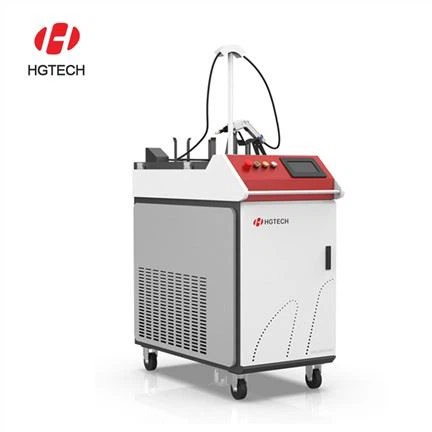


HW Series Handheld Laser Welding Machine
Product Description:
The handheld laser welding machine is a new type of welding method, mainly for the welding of thin-walled materials and precision parts. It can realize spot welding, butt welding, overlap welding, sealing welding, etc., the width of the weld is small, the heat affected zone is small, Small deformation, fast welding speed, smooth and beautiful welding, no need to handle or simple treatment after welding, high quality of welding seam, no porosity, precise control, small focus photoelectricity, high positioning accuracy, easy to realize automation.

Features:
1. The welding speed is fast, 2-10 times faster than traditional welding. One machine can save at least 2 welders a year.
2. The operation mode of the handheld welding gun head enables the workpiece to be welded at any position and at any angle.
3. No need for welding table, small footprint, diversified welding products, and flexible product shapes.
4. Low welding cost, low energy and low maintenance cost.
5. Beautiful welding seam: the welding seam is smooth and beautiful without welding scars, the workpiece is not deformed, and the welding is firm, reducing the follow-up grinding process, saving time and cost.
6. No consumables: laser welding without welding wire requires less consumables, longer life, safer and more environmentally friendly.

Welding penetration
Laser Power | Stainless Steel | Carbon steel | Galvanized sheet |
1000W | 0.5-1.5mm | 0.5-1.5mm | 0.5-1.2mm |
1500W | 0.5-3mm | 0.5-3mm | 0.5-2.5mm |

Boot-up workflow
1. Confirm that the external contact is normal, and open the rear of the device without opening;
2. Check whether the emergency stop switch is open normally. After confirming the switch, turn on the key switch, and then the machine power indicator will light up;
3. Confirm that if the equipment is normally powered on at this time, check whether the chiller works normally, check whether the water channel of the equipment is normal, if there is water leakage or the chiller is not working, please cut off the power and check;
4. Start the laser and select the external control mode (the specific way depends on different laser brands, if there is any difference, please consult the relevant technical personnel before starting the laser for the first time);
5. After the end of the laser self-test process (the laser self-test process is about 30 seconds, please wait patiently), you can operate the touch screen on the device;
6. Adjust parameter No. 1 on the touch screen to the welding requirement, click "Start" on the interface, then connect the protective ground clamp to the welding product, and the welding can be carried out through the touch button on the handgun;
7. During working and stop working, please note that the optical fiber is not bent by more than 60 degrees, and the extra optical fiber is hung on the optical fiber bracket;
8. When working, take it out from the hand-held welding gun rack. When working or suspended, please hang the welding gun on the bracket to avoid unnecessary losses.
Q:How does laser welding work?
A:
Laser welding can be achieved using continuous or pulsed laser beam, the principle of laser welding can be divided into heat conduction welding and laser deep penetration welding. The power density is less than 104~105 W/cm2 for heat conduction welding, when the melt depth shallow, slow welding speed; power density is greater than 105~107 W/cm2, the metal surface is concave into a "hole" by heat, forming a deep penetration welding, with a fast welding speed, the characteristics of a large depth to width ratio.
The principle of heat conduction laser welding is that the laser radiation heats the surface to be processed, and the surface heat spreads to the inside through heat conduction.
Laser welding machines for gear welding and metallurgical sheet welding mainly involve laser deep penetration welding.
Laser deep penetration welding generally uses a continuous laser beam to join materials, and the metallurgical physical process is very similar to electron beam welding, i.e. the energy conversion mechanism is accomplished through a "Key-hole" structure. Under sufficiently high power density laser irradiation, the material evaporates and a small hole is formed. This small hole filled with vapor is like a black body that absorbs almost all of the incident beam energy, and the equilibrium temperature inside the hole cavity reaches about 2500 0C. Heat is transferred from the outer wall of this high-temperature hole, causing the metal surrounding the hole cavity to melt. The hole is filled with high-temperature steam generated by the continuous evaporation of the wall material under beam irradiation, and the four walls of the hole are surrounded by molten metal, and the liquid metal is surrounded by solid material (whereas in most conventional welding processes and laser conduction welding, the energy is first deposited on the surface of the workpiece and then transferred to the interior by transfer). The liquid flow and wall surface tension outside the hole walls are held and dynamically balanced with the continuously generated vapor pressure inside the hole cavity. The beam continuously enters the small hole, the material outside the hole is continuously flowing, and the hole is always in a stable state of flow as the beam moves. That is, the small hole and the molten metal surrounding the hole walls move forward with the forward speed of the leading beam, and the molten metal fills the void left after the hole moves away and condenses with it, and the weld is formed. All of this happens so quickly that the welding speed can easily reach several meters per minute.
Q:Why should you choose laser welding?
A:
Traditional welding methods has many disadvantages, for examples:Difficulty in recruiting welders and high labour costs;Low efficiency, easily deformed and difficult to use;High cost of equipment and poor flexibility;High consumption of welding consumables;Radiation, fumes and harmful gases are damaging to workers' health.
On the other hand, laser welding has following advantages:
(1) can reduce the amount of heat input to the minimum required, the heat-affected zone has a small range of metallurgical changes, and the deformation caused by heat transfer is also minimal.
(2) 32mm plate thickness single-pass welding process parameters have been qualified, which can reduce the time required for thick plate welding and even eliminate the use of filler metal.
(3) No need to use electrodes, there is no concern about electrode contamination or damage. And because it is not a contact welding process, the wear and tear and deformation of the machine can be reduced to a minimum.
(4) The laser beam can be easily focused, aligned and guided by optical instruments, and can be placed at an appropriate distance from the workpiece, and can be redirected between machines or obstacles around the workpiece, whereas other welding methods cannot be used due to the above-mentioned space limitations.
(5) The workpiece can be placed in an enclosed space (by evacuation or with a controlled internal gas environment).
(6) The laser beam can be focused on a very small area, allowing small, closely spaced parts to be welded.
(7) A wide range of weldable materials and the ability to join various heterogeneous materials with each other.
(8) It is easy to weld at high speed by automation, and can be controlled by digital or computer.
(9) When welding thin materials or fine diameter wire, there is no trouble with reflow as in arc welding.
(10) not affected by magnetic fields (arc welding and electron beam welding is easy), can be accurately aligned with the welded parts.
(11) Can weld two metals with different physical properties (e.g., different resistance).
(12) No vacuum or X-ray protection is required.
(13) If welding by perforation, the depth to width ratio of the weld channel can be up to 10:1.
(14) The laser beam can be delivered to multiple workstations by switching devices.
What’s the main process parameters of laser penetration fusion welding?
1. Laser power
There is a laser energy density threshold in laser welding, below which the depth of melt is very shallow and once this value is reached or exceeded, the depth of melt increases substantially. Only when the laser power density on the workpiece exceeds the threshold value (material dependent), plasma is generated, which marks a stable penetration fusion weld. If the laser power is below this threshold, only surface melting of the workpiece occurs, i.e. the welding proceeds in a stable heat transfer type. When the laser power density is near the critical condition of small hole formation, penetration fusion welding and conduction welding alternate and become unstable welding processes, resulting in large fluctuations in the melt depth. In laser penetration fusion welding, the laser power controls both the depth of penetration and the welding speed. The welding depth of melt is directly related to the beam power density and is a function of the incident beam power and beam focal spot. In general, for a given diameter of the laser beam, the depth of fusion increases as the beam power increases.
2. Beam Spot
The beam spot size is one of the most important variables in laser welding because it determines the power density. However, its measurement is a challenge for high power lasers, although many indirect measurement techniques are available.
The beam focal diffraction limit spot size can be calculated from light diffraction theory, but the actual spot is larger than the calculated value due to the presence of focusing lens aberration. The simplest real measurement method is the isothermal profile method, which is to measure the focal spot and perforation diameter after burning and penetrating a polypropylene plate with thick paper. This method should be practiced by measurement and mastering the laser power size and the time of beam action.
3. Material absorption value
The absorption of laser light by a material depends on some important properties of the material, such as absorption rate, reflectivity, thermal conductivity, melting temperature, evaporation temperature, etc. The most important one is the absorption rate.
Factors affecting the absorption rate of the material to the laser beam include two aspects: firstly, the resistivity of the material. After measuring the absorption rate of the polished surface of the material, it is found that the material absorption rate is proportional to the square root of the resistivity coefficient, which in turn varies with temperature; secondly, the surface state (or finish) of the material has a more important effect on the absorption rate of the beam and thus has a significant effect on the welding effect.
The output wavelength of CO2 laser is usually 10.6μm, the absorption rate of ceramics, glass, rubber, plastic and other non-metals is very high at room temperature, while the absorption of metal materials at room temperature is very poor, until the material once melted or even vaporized, its absorption increases sharply. The use of surface coating or surface generation of oxide film method to improve the absorption of the material to the beam is very effective.
4. Welding speed
Welding speed has a large impact on the depth of melt, increase the speed will make the depth of melt shallow, but the speed is too low and will lead to excessive melting of the material, the workpiece weld through. Therefore, there is a suitable welding speed range for a certain laser power and a certain thickness of a particular material, and the maximum depth of melt can be obtained at the corresponding speed value in it. Figure 10-2 gives the relationship between welding speed and depth of melt for 1018 steel.
Hot Tags: hw series handheld laser welding machine, manufacturers, suppliers, price, for sale
Send Inquiry